Fuel Switch Routes: Verified emission reductions by default
For freight forwarders and logistics providers, helping customers reduce and document transport emissions is becoming a more important part of the service offering. In ocean freight, this means finding solutions that can be applied within existing LCL flows, without adding unnecessary complexity to the booking process.
At the same time, customers need credible documentation to show what has been done and how emissions have been reduced. This is where verified maritime biofuel insets can play an important role.
Greencarrier Consolidators’ Fuel Switch Routes are one way of how verified emission reductions can be integrated into standard consolidation services. All Less-than-Container Load, LCL, import shipments from Shanghai to Hamburg and Gothenburg now include verified maritime biofuel insets by default, at no extra cost to customers.
The purpose is to make lower-emission shipping easier to access and easier to document, both for freight forwarders and for the customers they support. In the bigger picture, the initiative is also a way to accelerate the transition toward fossil-free shipping.
How Fuel Switch Routes work
Maritime biofuel insets are based on a book-and-claim model. Certified maritime biofuel is supplied into the marine fuel system, while the corresponding emission reduction is allocated to a specific shipment.
For LCL shipments on the Fuel Switch Routes from Shanghai to Hamburg or Gothenburg, this process is handled automatically. The shipment is booked as usual, and verified maritime biofuel insets are matched to the transport in the background.
The result is a documented reduction of fossil emissions connected to the shipment, supported by third-party verification. Documentation can be provided to customers upon request, and at the latest by the end of the year.
Why the insets are included by default
On these specific routes, maritime biofuel insets are not offered as an optional add-on. They are included by default.
This approach is based on a practical insight: many companies are interested in reducing transport emissions, but additional cost, separate approval processes and shipment-by-shipment decisions can slow down adoption. By including verified maritime biofuel insets automatically, Greencarrier Consolidators lowers the threshold and gives more customers the opportunity to experience how the solution works in practice.
“Our ambition is to make it easier for customers to take the first step. Instead of asking them to add maritime biofuel insets shipment by shipment, we include them by default on these routes. This allows customers to see the verified impact, receive the documentation and hopefully consider using biofuel insets for more of their shipments going forward,” says Tim Jurischka, CEO Greencarrier Consolidators.
The aim is to reduce emissions on selected routes, while also building awareness of maritime biofuel insets as a credible option for more transport flows. It is also a strategic investment for Greencarrier Consolidators, proactively addressing emissions on some of its most important LCL trade lanes.
Documentation customers can use
Several customers have already used the Fuel Switch Routes and received certificates confirming the verified emission reductions connected to their shipments. This documentation has been well received, especially as many companies are working more actively with Scope 3 follow-up, procurement requirements and sustainability communication.
For freight forwarders, the certificate can also support the dialogue with their own customers. It provides a clear document showing that a concrete emission-reduction measure has been applied to the shipment.
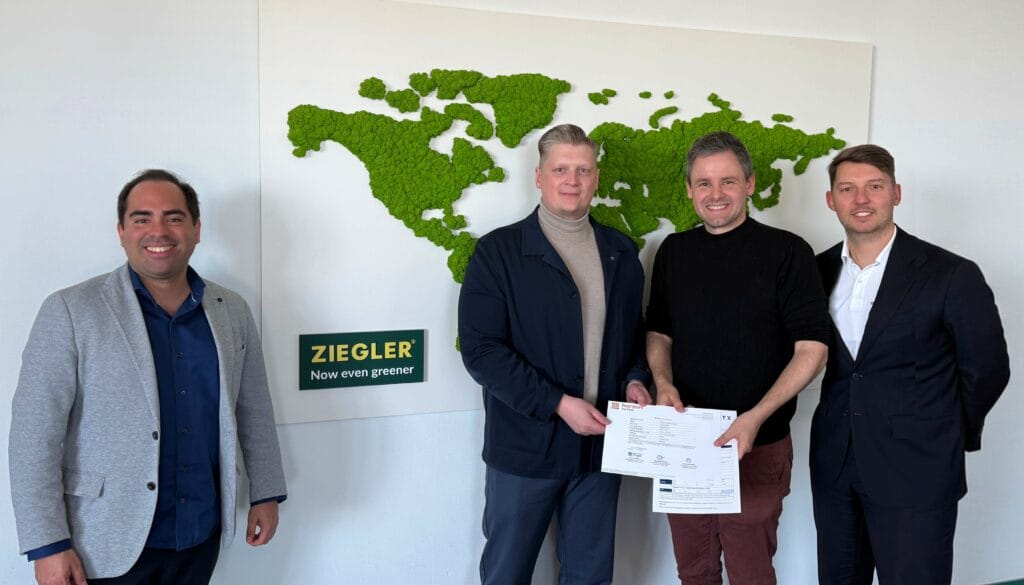
“Greencarrier’s biofuel insetting program takes the complexity out of decarbonization. The official certificate allows us to seamlessly provide our customers with rock-solid, verified evidence of real CO2 savings for their shipments. This greatly supports our sustainability efforts and adds immense value to our customer relations.“ — Lars Schröder Ramirez, Head of Communication and Marketing DECH, Ziegler GmbH.
From left: Lars Schröder (Ziegler), Patrick Westraeus (Greencarrier), Matthias Pichler (Ziegler) and Tim Jurischka (Greencarrier).
A practical step toward broader use
Fuel Switch Routes show how emission-reduction measures can be integrated into everyday logistics. When verified maritime biofuel insets are included by default on selected trade lanes, more shipments can be covered without requiring a separate decision for each booking.
For freight forwarders with LCL import shipments from Shanghai to Hamburg or Gothenburg, the service provides a practical way to offer verified emission reductions within an existing transport setup.
For shipments outside the Fuel Switch Routes, Maritime Biofuel Insets can also be added to other shipments, regardless of destination. In these cases, the inset is selected as a paid option by the customer.
This makes it possible to use the same verified approach beyond the Shanghai–Hamburg and Shanghai–Gothenburg routes, for companies that want to reduce and document emissions from more parts of their transport flows.
Subscribe and receive the latest industry insights and news from us – every week!
Cookies
We serve cookies. If you think that's ok, just click "Accept all". You can also choose what kind of cookies you want by clicking "Settings".
Read our cookie policy